Articles
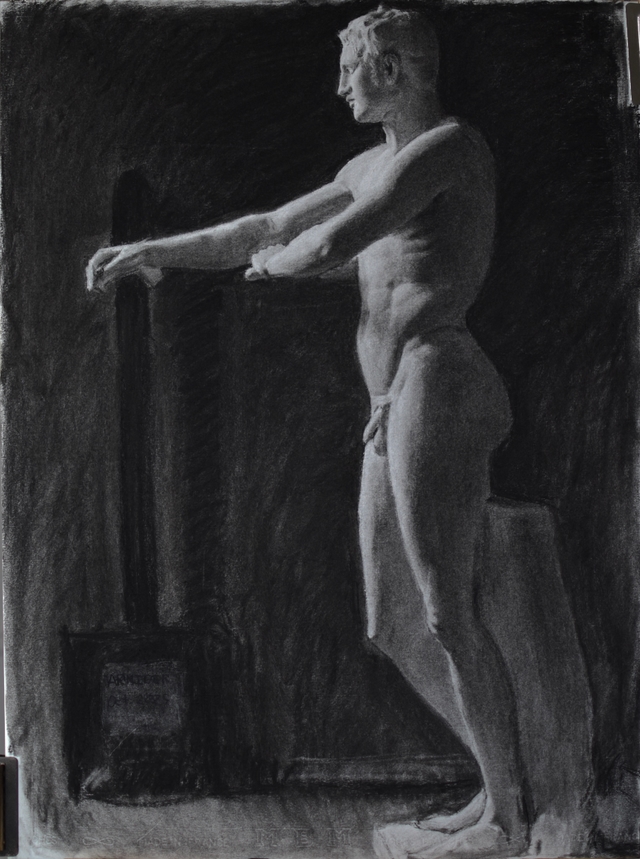
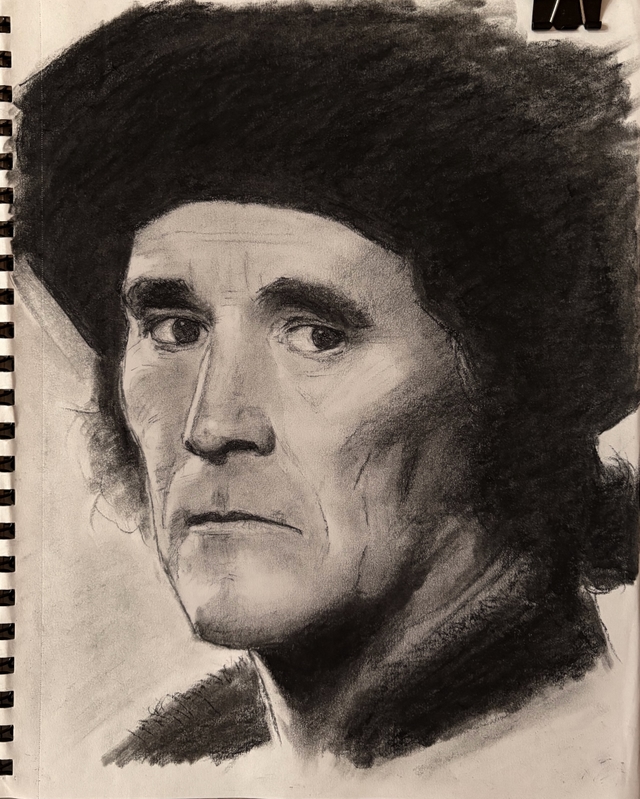
I’ve found myself with a great desire to do more than just study art skills. The beginning of my artistic endeavors were founded on simple curiosity, but the more I trained the greater my ambitions became. While the artists I came to love did train to be masters of their craft, the impetus that brought them into my view centuries later was their dedication to creating great works of art. How could I do anything except emulate them? To make great works I needed to build a foundation of knowledge. I lacked the draftsmanship skills to even begin conveying my ideas effectively on paper. I couldn’t represent the effect of light on a scene or express the raw emotion behind a person’s character. Fortunately, I happened upon a historical training philosophy that would become an empowering catalyst to my artistic abilities. This drawing I made about a year ago was the culmination of my curiosity: drawing most days, watching free tutorials, and pushing myself to try new things. It’s a decent portrait and I was proud of it, but in hindsight I know I didn’t understand what I was doing at the time. I opted for naive observation when I didn’t have the knowledge or ability to understand relationships between structures and light. It took me 6 hours to complete the portrait because most of what I’m doing is guessing. Of course, I wanted to keep getting better. It wouldn’t have been all that hard to continue drawing consistently and scrolling through Pinterest to find references. That alone could carry you forward, but it also felt a little aimless. I started to be bored of it and found myself unsure of what to draw next. Luckily around this time, among the wash of YouTube tutorials and reddit recommendations, a Youtuber called JakeDontDraw had piqued my interest with his talks of 19th Century training. The historical aspect of it personally interested me, but the training felt more substantial and simple than anything else I saw on the internet. To me it sounded like a craftsman’s approach to training: refining a basic set of skills that inherently allow for a greater capacity of work. The structure of 19th Century French training was drawing the figure constantly while being directed by the materials used, adhering to time limits for studies, and “graduating” to different dimensionalities of work. I use quotes because these graduations are done loosely (as the French do), and my guess is that these systems are put in place to run a school as much as it is to teach students. The students were started on drawing from the cast or sculpture. Once they achieved a tolerably fair drawing they were moved to drawing from the model, which is a person that poses for them. These drawings were generally done for 12 hours on 18”x24” paper and with charcoal and stump. Once they got good, they were moved to painting, which required them to not only manage the drawing but also colors and mixing. Bargue plates could also be considered a stepping stone to this type of academic training. Those French students made a 12 hour drawing every week for years at the École des Beaux Arts. I figured that if they could make hundreds I could make one (a maxim that sums up the simplicity and ease of picking up the structure). This was my one. It’s not done on the prescribed paper, and I spent 7 hours on it instead of 12, but none of that really matters yet. I spent as long on it as I could (not to mention it’s the longest I had ever spent on any drawing) and followed the general advice given by Jake which includes counting the head heights of the figure, spending a while on the general block in to place the proportions, and finding a separation between light and shadow. I was proud of this because I gave my best effort and I understood the purpose of the practice. Once finished I only had a taste for more. I was still trying to understand how to manipulate charcoal and stump. It can feel clunky, and the sticks and crayon require more maintenance to keep sharp than a graphite pencil. I was also not using enough charcoal material; much is needed to create convincing light. But most of all, I needed to improve my fundamental skill of observation. More high effort drawing would be tremendously helpful for these responsibilities. Over the next two charcoal figures I started to get better proportional accuracy. I’m spending all of my brain bytes trying to put down decent lines at the correct angles as well as managing my materials. Many problems of the first drawing remain, but there is substantial improvement in my ability to represent a natural looking figure. I also begin to follow the prescribed materials more closely. With this experience and Jake’s guidance I started to build the context needed to understand what it means to model forms with light and shadow. I then take up charcoal figures like it’s my job. The rest of these are done in the remainder of the year. Not every drawing is necessarily more successful than the last, but in each one I was pushing different ideas whether it was finding accuracy and rhythms, modeling forms, or making a striking ensemble by controlling gesture, light, and edges. I make noticeable improvements in my figures in a matter of weeks and months. Many hours at the easel trained my eye to observe proportions and light more effectively. I established important checks in my work such as squinting to recognize clumps of light and dark or thinking about how light must behave as it moves across forms to inform my observation. I was no longer so befuddled by sticks and paper. Putting down lines felt more similar to a carpenter striking his hammer rather than doing calculations without a calculator (as myself). As I built up my capacity to handle complexity, it was the rendering and organization of values that became the meat of the drawing. The proportional work is perhaps most important as a rule, but to shade a figure with infinite complexities requires understanding, boldness and subtlety that is exciting to me. First I got better at shading large forms, like the torso, head, and limb, which are often made up of the whole gamut of light and shadow in the drawing. These big forms are something like spheres or cylinders in summary, and the way light travels across them can be thought of as such. Gradually, an increasing sensitivity to what I observed allowed me to better manage more specific forms such as a bulging abdominal muscle sitting on the stomach or the roundness of the pec where it leads to the armpit. These forms sometimes lie entirely within the lights or shadows, so more careful gradations of value are needed to model them without breaking the picture. As my ability to handle specific information improved, so did my capacity to think of the greater picture. This could be conveying the falloff of light as it cascades down the figure, bringing to each height a different value of light, or finding satisfying rhythms across the figure that create a beautiful posture. The 12 hour figure brought these skills to fitness like an athlete’s conditioning. Simultaneously, it internalized good drawing habits and information about the human body. I more often considered not whether a line was right but whether pieces of the drawing made sense. All of this is not to say that I necessarily studied these things individually or on purpose. Rather, they are the consequences that drawing the figures had on me as I gave my greatest effort to each one. The portrait above benefits from the year of work I’ve described. I’m better at representing planes of light and grouping values, and I have a greater propensity to create striking work. I completed this portrait in around 3 hours, half the time of the first example . I’ve realized the mode of diagnosing problems from the figure and seeking to resolve them during the next is the true structure of my training. I practically never find myself wondering what I should do next because when the syllabus for improving draftsmanship is the human figure itself, there is never a lack of lessons to learn. Another boon of this study is that it fosters ambition. I often put down the stump and charcoal to explore other mediums and subject matter. My foundation of draftsmanship props up and perpetuates all of my explorations. The 12 hour charcoal figure has been a barometer to measure from, and it is my desire for a greater picture that’s guided me. Most importantly, it is training that has equipped me to do more than study and attempt to create skilled, original work like the masters before me.
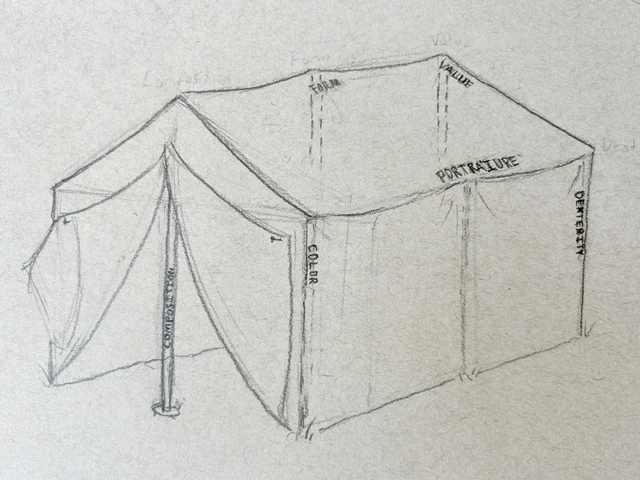
Art, whether it’s a painting, comic, or animated movie, is one of the most widely accessible and universal forms of entertainment. Even so, artistic skill has a culture of mysticism and high brow learning surrounding it. Many laymen don’t understand that drawing is a practiced skill, like a trade, rather than something acquired at birth. On the other side, most art schools don’t teach the fundamentals needed to become a skilled artist, leaning into abstract and expressionist work. Or, they’ve developed convoluted methods of learning that’s unnecessary and inaccessible to the average person. There’s also a proliferation of plainly bad advice on social media and the internet. Misinformation and a lack of good contemporary academic grounding makes it exceptionally difficult for beginners to become good at art when learning on their own. However, learning art can be simple, and all art is built on the same fundamental skills. So, instead of providing yet another roadmap for what and how long fundamentals should be studied or even give a specific lesson on improving fundamental skills, I want to establish a generalized framework for learning that can offer guidance to young artists in hopes that they will not stray from reasonable learning. An unofficial and non exhaustive list of fundamentals include: Composition Value Gesture Form Dexterity/Linework Portraiture These fundamentals are the foundation of an artist’s work, the scaffolding that supports and elevates it. Strong foundations allow the artist to focus on the subject of their work, enabling creative freedom to express what they will, rather than struggling to command their work. The importance of fundamentals can’t be understated, but some artists neglect them and simply follow their own whims of creativity, which ultimately, in my opinion, leads to a limited ability to create interesting work. In contrast, but also detrimental to improving skill, young artists will pursue improving the fundamentals but do so incompetently. They lead themselves astray by harping on a single fundamental to exhaustion, and, although they may have limited results in their chosen obsession, they are likely to be demotivated by their monotonous learning. Of course, these artists have good intentions, but people often look for efficient methods of learning, which can lead to relatively extreme methods of learning, or they have no method at all. Cyclical Learning If an artist is to avoid both a lack of regiment and an over regimented education, then they must strike a balance. The correct balance will change from one artist to another, but hopefully after reading this article you’ll be able to steer yourself onto a good path for learning The path to becoming a master is not by attempting to master one fundamental before moving to the next. It is refining all of your fundamental skills repeatedly until your work is brought up to a master’s level. You work on skills, move on to a new skill, and then return to refine old skills, which in turn elevates your work as a whole. In this diagram I show the fundamental skills as poles of a tent. Each pole carries its share of weight, but if another pole is missing or too short then the tent will still sag and stop functioning in its purpose. You may raise a single tent pole very high, but it does not make your tent much better. I will attempt to stop saying poles soon, but if you raise all of your poles similarly then you will have a decent tent all the while and the higher the poles, the greater your tent. All this to say that if you improve all of your skills, then you will create better work as a result, and if you neglect your poles then you will not have a good tent! I suggest artists uptake a round robin form of education by simply trying new things and also returning to old things. Do not look at a new medium or subject as something you are just “bad” at, but instead as a new thing to learn that will improve all the work you do. This keeps an artist from stagnating and also sustains interest. I find that there are even great artists who seem to have stuck with what works for them and their career, and their work seems to have more or less been of a similar quality for years. This also happens to beginner artists. For example, a beginner may like to draw anime, but then all they draw is anime for years. They may get better at copying anime, but soon their skills stagnate. This isn’t to say that they don’t move on to new things eventually, but much time and effort could be saved if they were consistently pushing into new territory. I have also seen artists who do push into doing new things but neglect some fundamental skills, and as a result all of their work is held back by it. Rob Liefeld is a contemporary example of this. He created exciting, fresh comics, but his ineptitude at drawing the figure came back to bite him (although I think he’s hated far too much). Getting Started, Broadly Draw from life. Whether it's from a photo or something right in front of you, being able to represent life naturally is going to build the strongest foundation for whatever you want to do. Sprinkle in different mediums in your practice, but the majority of your learning is best to be done in graphite and charcoal. Quick sketches (10 minutes to an hour) are valuable for getting repetitions and lots of practice. Longer drawings (multiple hours) are great for improving your rendering skills and getting more accurate and finished pieces. Do both! Lastly, although controversial, I recommend learning with traditional materials (not digital). This simplifies things for you, and digital is more likely to hold you back in the beginning than help you. Learn from different teachers, read from different books, and don’t subscribe yourself to only one source of information. There isn't really one "right" way to do anything (although I do recommend avoiding complicated techniques in favor of simplicity). Everything you learn you will carry with you, and, in my opinion, having some variety will make you a more interesting artist. Seek feedback, but only listen to good feedback. Good feedback usually critiques or touches on your fundamental skills, rather than superficial details of your drawing. Be interested in other artists! Find artists you love and attempt to understand why you love them. As You Get Better As you refine your skills, you’ll find that some things that used to be hard are now easier. This opens up your cognition (or brain bytes as I like to call it. It’s also a similar concept to spinning plates.) to focus on more and reach further while making art. When you are better at a certain skill, it allows you to focus on other things. I think this is the basic mechanism of getting better! Although this seems like a simple concept, it provides a lot of insight on how we learn and how we can approach learning. For example, an artist that has difficulty creating a tolerably fair portrait in Charcoal, which only requires manipulation of light and dark values, will have even more trouble creating a fair portrait in Oil paints, because it requires the manipulation of value and color. Now, this isn’t to say that you should withhold yourself from doing anything until you consider yourself ready. In fact, don't do that. It should instead inform you of what skills you may need to improve after attempting the thing that is hard or unfamiliar. In my opinion, to become a great artist you need to push into the unfamiliar. Seek it as a challenge to overcome. The process of exploring new things shouldn’t be overly stressful, but instead you can hopefully follow your curiosity where it takes you while not letting your fear tame you. There are literally zero stakes in trying a new medium or drawing a subject you’re unfamiliar with. I encourage artists to take an optimistic and mature approach to learning that is not demeaning or centered on insecurity. Also, take a look at your old work every once in a while to see how far you’ve come.
At the end of my last post, I mentioned that I would be focusing on value and rendering, and that’s exactly what I’ve done! It turns out graphite is an arduous medium for creating rendered drawings with a wide value range. At the advice of internet people, I’ve started using charcoal, a lot. The following is a chronological gallery of what I’ve been doing with Charcoal the past month. This was my first attempt with charcoal. I lacked dexterity with it, but I could tell that it was immediately easier to get a greater value range. I kind of like the drawing, but the proportions are more off than I can condone. I believe this is because I was using a lot of brain bytes trying to manipulate the charcoal. I’ve found that when trying out new drawing skills, it causes other things to suffer a little, like my proportions here. In this attempt, I used a different type of charcoal that is a little more waxy and less dusty. I have my shadows and lights separated well here, but there’s a lack of halftones and transitional values. Now this was my first charcoal drawing that felt like something. Through my practice I had built up some dexterity with charcoal. I became more familiar with how it moves on the page and was able to spread it around with my finger to create halftones with it. Sharpening my tools properly with a razor and sandpaper also helped a lot. I like the form of her hair and the overall gesture of the head and face. Then I began learning how to draw drapery with charcoal as preparation for a small project. I had to build even greater dexterity. Not only controlling values but also their hard and soft transitions, which is very important for the folds of drapery. These are semi successful. I really like this piece, and it’s the only art I’ve given to someone else! This is the small project that I prepped for. I had to make sure I could draw the folds of her clothes well. And charcoal doesn’t always erase well, so I knew I couldn’t totally botch it. My youngest cousin had taken some interest in drawing the past few months. Over the holidays she even drew with me, and I let her draw in my sketchbook, so I decided to gift her some supplies. I drew this in a sketchbook and sent it to her. The reference is a photo of The Annunciation sculpture by Sigrid Blomberg. I did this piece for a bi weekly challenge that is held by the internet forum I’ve joined. It took about 4 hours. I’m pretty happy with the rendering, but the proportions look slightly goofy. As a result, I vowed to never again allow a drawing to fail due to its proportions. What am I, an amateur? I also like the composition, which has been something I’ve made a priority, even in more casual sketches and drawings. It makes a surprising difference, even if the drawing itself is subpar. In my vindication, I came back with this 6 hour study. Not only was I able to go very dark with the charcoal, but I could also spread it around with my finger, which helped make the midtones you can see in places like the side of the nose. I used an eraser to emphasize the highlights. I’m especially happy with this since I managed the complex lighting situation where his face is lit by ambient light and also a brighter light source shining from the left. The proportions, values, and composition are all done well. Charcoal is such an excellent artist tool. It’s what most traditional art academies will teach you with, and there’s also tons of wonderful artwork done in charcoal. I would say that it’s really a necessity if you want to learn how to control values well, since it actually enables you to lay them down. I still do casual sketches in graphite, but charcoal is now my go to for more finished drawings. If you want to learn more about charcoal and also get a hint at where my art journey is taking me, check out this thoroughly written article.
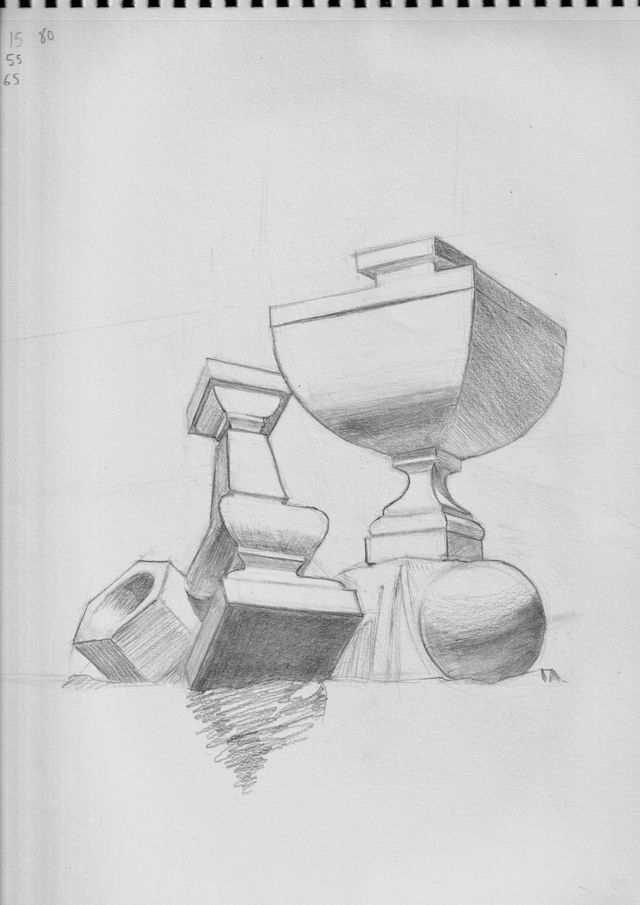
I’ve joined an internet forum where there are bi weekly challenges, and the latest one was to draw a perspective heavy scene from a provided reference. This might be my longest drawing at nearly 4 hours . Perspective is hard, and I decided not to use any rulers and hand jam everything. I do like how this turned out, and besides getting the perspectives (mostly) correct, I knew what I wanted to do to design this piece to look aesthetic. I needed it to be clean. The problem I saw with some other submissions (or at least something I didn’t like) is that even if they had nice rendering, their lines were messy or lacked variety. The variety I speak of can be see among the objects above. I have keyed in lines, soft lines, and a lost line. The “keyed in” line is something I learned to do from a figure drawing instructor here in NY, and it’s where you create a dark mark to key in your value scale. You can see that I keyed in the corners of the base of the pedestal. I usually did these when the line bordered two contrasting values (light and dark), but some of that information isn’t there since there is no background. However, the key ins create some variety and visual interest regardless. Alternatively I have softer lines or lost lines where there is less value change. The top left portion of the circle is a lost line. The line isn’t there (except for erase marks), so your brain uses context to fill in the information. Another lost line I like in this piece is the bottom portion of the hexagon’s intrusion, where the edge of the cut meets the hole. And lastly, this lost line on the shaded side where the curve meets the flat. My rendering (AKA shading) is still lacking. I can’t really even make a gradient or control my value scale, so that will be a greater focus for me in the coming weeks.
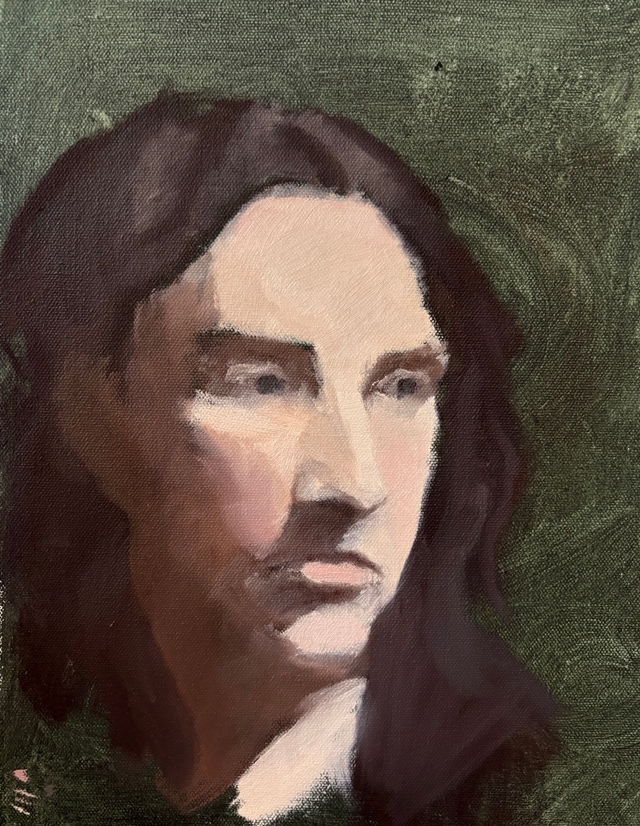
I did these paintings at a class that supplied all materials. Each painting was 2 2.5 hours, which is a relatively short amount of time for an oil painting, and they were all from a live model. Being new to painting, there were a lot of new factors I had to consider while doing these. When putting brush to canvas, it briefly felt as if I had forgotten how to draw. A pencil or pen are precise tools so the thickness of a brush felt clumsy, but I quickly got over it as I had more important matters to attend to. Managing your paint materials is akin to managing a kitchen. You’re taking measurements and it’s messy, and you’re under the duress of finite time. Your pots and pans are your brushes, solvents, and paints. There’s a rhythm to find that makes managing everything run smoothly, otherwise you’ll be fighting your materials when you should be fighting to make something that looks like a human head on canvas. This was my very first painting. I used a full pallet of 8 colors. We were taught to tone our canvasses, so the blue shade in the background is the tone. I should have made it darker, since I was painting a model with a dark background. Color hues and values are local, so changing the background color can substantially change the look of the figure you’re painting. Mixing paints is an art in itself, and here I couldn’t quite get normal, human looking colors, but she has an earthy hue that I don’t mind too much. I think I placed the shadows solidly, and her look is sort of expressive. In my second painting, I moved to a simplified pallet of primary colors (red, yellow, blue) + white. A primary color pallet is what most painters should start with, so that you can learn what colors actually look like and what they are made up of. Adding more colors to a pallet is an acceptable shortcut that painters will begin to use later on, but for now I wanted to mix everything. I think this painting is fine. It looks more like the model, and I have real colors going on. However, it’s mostly two tone. I have the hard shadows and lights, but I’m missing most of the transitional values. In my final painting, I continued with the primary color pallet, and I also used two separate brushes for light and dark values. This made applying paints considerably easier. Something substantial I learned from my instructor during this painting is that I should consider the color of the shadows. Cold colored shadows can make a figure look lifeless. I tried course correcting to warmer shadows near the end of the session. I also have a nice value transition on the cheek. Overall, I loved doing oil paints. It adds a whole new dimension to drawing, and I love wrangling the complexity of it all. I can’t wait to do more, and it’s piqued my interest in the paintings of Masters. But, the basis of all art, even painting, is still drawing!
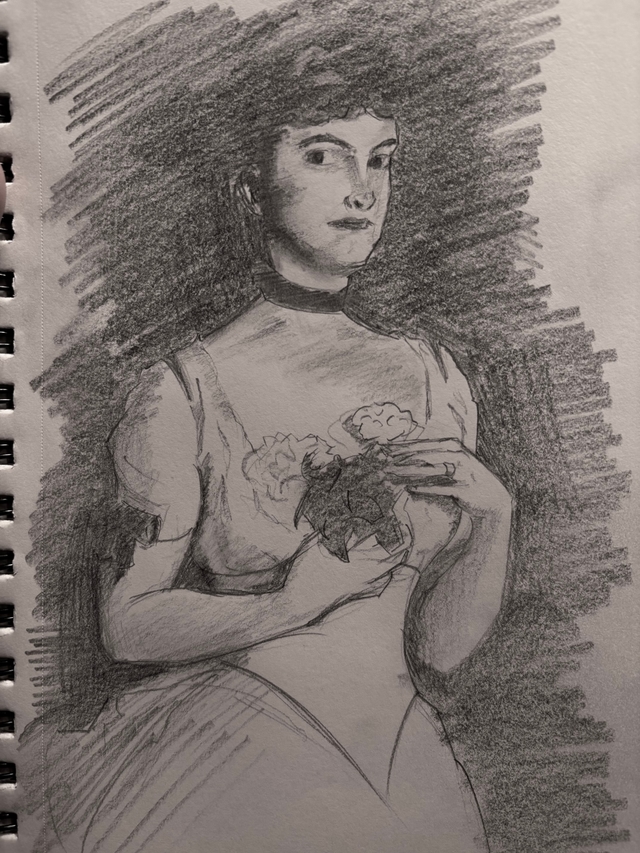
I've been getting into master studies recently thanks to an artist I've been watching called Katie Maeve, and what better artist to study from than John Sargent who is one of the most well regarded portrait painters of all time. Something I wanted to practice in this study is his use of hard and soft lines. The hard lines create contrast with the background to bring the viewer’s eye to important parts of the piece such as her face and hands, while the left side of the figure fades into black. There is also some soft lines between the flowers she holds and her dress. My implementation somehow feels heavy handed in some areas, but this was a good value and lines study for me. I like how her arms turned out, and I also like how I conveyed her face using values.
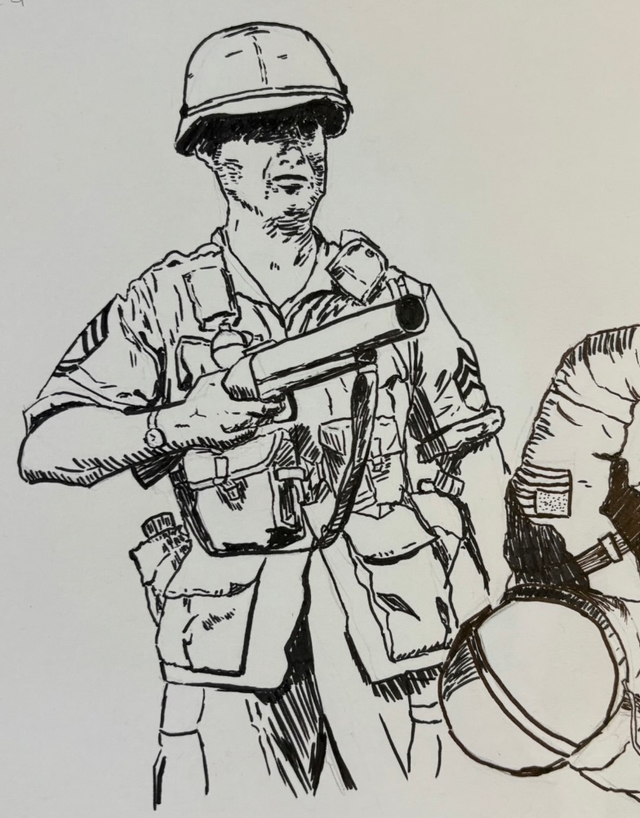
I've been inspired by Karl Kopinski lately so I've started drawing soldiers and astronauts. I had a couple things I wanted to practice with this type of drawing: Get better at drawing bags, cloth, accessories, etc. Start with a very loose sketch and then tighten it up in pen, like Kopinski often does. This method of drawing, which I've dubbed Loose Pencils, Tight Ink , is fun because it avoids the exhaustive process of creating a detailed drawing in pencil and then having to go over it all in ink. However, it also requires some skill and delicacy since you do not have all the visual information down while inking. Here are a couple other soldier drawings I did with similar aspirations, but these were done with tight pencil sketches or were not inked:
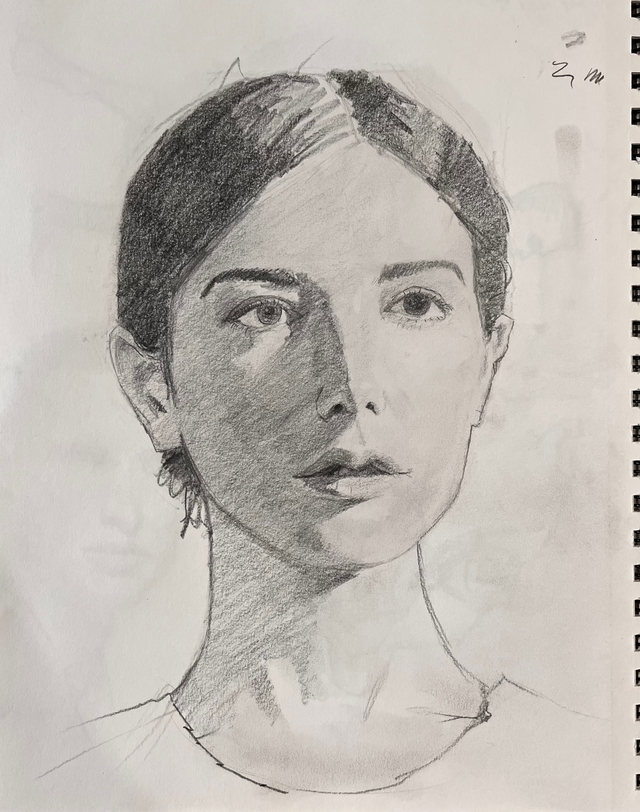
I view this piece as a turning point in my ability to draw portraits. Rendering and values have long been something I’ve neglected to study, but they are inherently important when creating portraits. After watching Katie Maeve draw and really grasping how to see values, my portraits have gotten much better. Part of this understanding of values is the understanding of how to draw facial features with value rather than lines. When you’re drawing lines instead of values, your portraits will end up looking like this: Date: March 2024 Now while there’s a lot of things wrong with these portraits, you can see that I’m drawing what the art community calls “symbols” for the features of the face, rather than what the features actually look like. I did this most conspicuously with their eyes, which I’ve drawn in almond shapes like many new artists do. In my more recent portrait, you can see that I let white/light value blend into the eyes and lips. That is drawing with value, and it has improved my portraits substantially.